Mussel
Zebra Mussel
Dreissena polymorpha
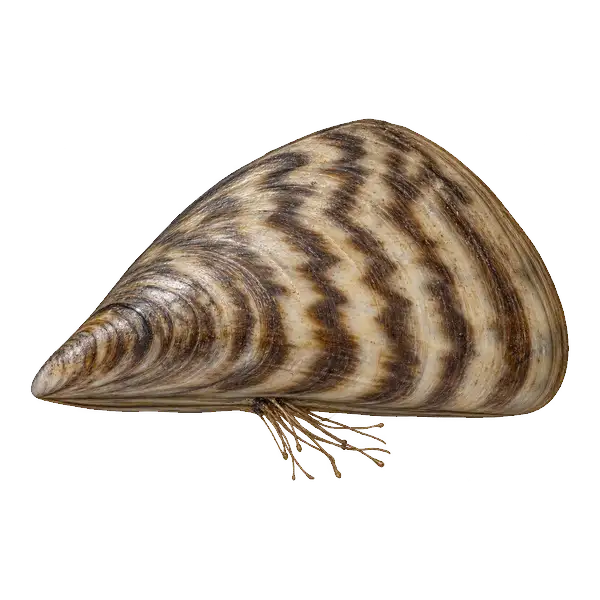
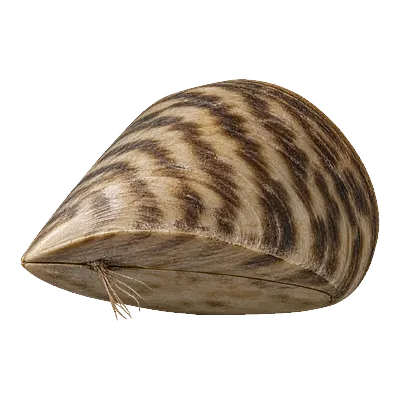
These illustrations are AI-generated, not photographs, and are not to scale. They show what to look for; they are not a substitute for an expert identification.
How to identify it
Size: About 1 inch long, often smaller.
- A D-shaped or triangular shell with a sharp ridge along one edge.
- A flat underside, so the shell sits upright if you set it down.
- Dark and light zigzag or wavy stripes. The pattern varies and can be faint.
- Fine threads that glue it to rocks, docks, boats and other shells, often in clusters.
Don’t confuse it with
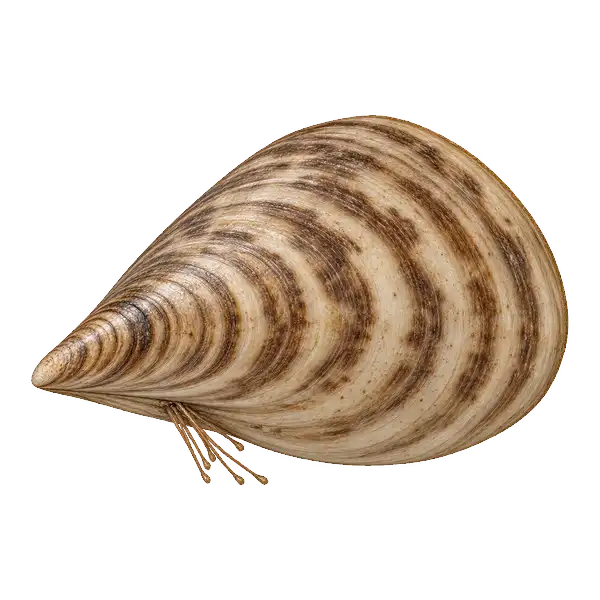
Quagga mussel, another invasive, is rounder and has no flat underside: set one on its side and it rolls over. Native mussels are much larger, have no attachment threads, and live partly buried in the lake bottom.
Where it came from
Native to the Black Sea and Caspian Sea region of eastern Europe and western Asia.
Carried to the Great Lakes in the ballast water of ocean-going ships in the 1980s. It reaches inland lakes mostly on boats, trailers and gear, and as tiny free-floating young in bilge and live-well water.
Earliest dated Minnesota record: 1989, Mud Lake, St. Louis County. This is the oldest dated record in the USGS non-native species database, not necessarily when it first arrived.
Why it matters
Zebra mussels filter large amounts of water, removing the plankton that young fish and many native animals feed on. They coat docks, boat hulls, water intakes and native mussels, and their sharp shells cut bare feet on beaches.
Minnesota law
Designated a prohibited invasive species under Minnesota Rules 6216.0250. It is illegal to possess, import, purchase, transport or introduce it, except under a DNR permit for disposal, control, research or education. Named in Minnesota Rules 6216.0250, subpart 4, item J. Minnesota DNR’s summary of these laws.
If you find it
- Don’t move it. Minnesota law requires you to clean aquatic plants and prohibited invasive species off boats, trailers and gear, and to drain all water and leave drain plugs out while transporting. Launching a boat or trailer with aquatic plants, zebra mussels or other prohibited invasive species attached is illegal, and docks, lifts and rafts must stay out of the water for 21 days before going into another body of water. What Minnesota law requires
- Never release bait or pets. Minnesota law forbids dumping bait in any lake or river: put unwanted bait in the trash. Never release bait, plants or aquarium pets into Minnesota waters.
- Report it. Note the exact location, take a photo, and contact the Minnesota DNR aquatic invasive species specialist for your region, or call the DNR at 888-646-6367. Experts there can confirm what you found.
- Ask before removing or treating. Aquatic plants in Minnesota public waters belong to the state. Applying herbicides always needs a DNR permit, and so does cutting or pulling submerged plants over more than 2,500 square feet. When a permit is needed
Minnesota lakes where it has been recorded
346 Minnesota lakes on this site have a record of this species.
Aitkin
Big Pine Lake, Cedar Lake (Main Basin), Cedar Lake (N.E. Arm), Cedar Lake (West Bay), Farm Island Lake, Round Lake, Spirit Lake
Becker
Big Cormorant Lake, Buffalo Lake, Detroit Lake, Eagle Lake, Floyd Lake, Fox Lake, Lake Eunice, Lake Ida, Lake Maud, Lake Melissa, Lake Sallie, Leif Lake, Little Cormorant Lake, Long Lake, Munson Lake, Pickerel Lake, Toad Lake, Turtle Lake, Upper Cormorant Lake, White Earth Lake
Beltrami
Andrusia Lake, Big Lake, Cass Lake, Lake Bemidji (main lake), Lake Irving, Lake Marquette, Pimushe Lake, Stump Lake, Turtle River Lake
Big Stone
Carver
Burandt Lake, Lake Ann, Lake Minnewashta, Lake Riley, Lake Virginia, Lake Waconia, Lotus Lake, Miller Lake, Piersons Lake
Cass
Bowen Lake, Boy Lake, Broadwater Bay, Girl Lake, Gull Lake, Hand Lake, Inguadona Lake (N. Bay), Inguadona Lake (S. Bay), Lake Winnibigoshish, Leech Lake (Kabekona Bay), Leech Lake (Main Basin), Little Boy Lake, Pike Bay, Pine Mountain Lake, Portage Lake, Roosevelt Lake, Steamboat Lake, Sylvan Lake, Tenmile Lake, Thunder Lake, Woman Lake (main lake)
Clay
Clearwater
Crow Wing
Bass Lake, Bay Lake, Bertha Lake, Big Trout Lake, Clark Lake, Clear Lake, Cross Lake Reservoir, Daggett Lake, Gladstone Lake, Horseshoe Lake, Huntington Mine, Island Lake, Kimball Lake, Lake Edward, Lake Hubert, Little Pine Lake, Love Lake, Lower Cullen Lake, Lower Hay Lake, Lower Whitefish Lake, Mahnomen, Alstead & Arco Lake, North Long Lake, Ossawinnamakee Lake, Pelican Lake, Perch Lake, Pig Lake, Rabbit Lake (West Portion), Rice Lake, Round Lake, Rush Lake, Ruth Lake, Serpent Lake, Smith Lake, South Long Lake, Upper Hay Lake, Upper South Long Lake, White Sand Lake
Dakota
Douglas
Blackwell Lake, Burgen Lake, Chippewa Lake, Freeborn Lake, Grants Lake, Lake Aaron, Lake Andrew, Lake Brophy, Lake Carlos, Lake Cowdrey, Lake Darling, Lake Geneva, Lake Henry, Lake Ida, Lake Irene, Lake Jessie, Lake Latoka, Lake Le Homme Dieu, Lake Louise, Lake Mary, Lake Miltona, Lake Victoria, Lobster Lake (East Bay), Lobster Lake (West Bay), Maple Lake, Mill Lake, Pocket Lake, Red Rock Lake, Smith Lake, South Oscar Lake, Turtle Lake, Union Lake, Whiskey Lake
Goodhue
Hennepin
Bde Maka Ska, Bryant Lake, Christmas Lake, Fish Lake, Lake Harriet, Lake Independence, Lake Minnetonka, Medicine Lake, Rice Lake
Hubbard
Big Sand Lake, Fishhook Lake, Garfield Lake, Kabekona Lake, Lake Plantagenet, Little Sand Lake, Long Lake, Potato Lake
Isanti
Itasca
Ball Club Lake, Bass Lake, Blandin Lake, Bowstring Lake, Dora Lake, Jessie Lake, Little Sand Lake, Little Winnibigoshish Lake, Moose Lake, North Star Lake, Sand Lake, Swan Lake (Main Basin), Swan Lake (West Bay), Trout Lake, Turtle Lake
Kandiyohi
Andrew Lake, Diamond Lake, Eagle Lake, Elkhorn Lake, George Lake, Green Lake, Henderson Lake, Lake Calhoun, Lake Florida, Long Lake, Long Lake, Nest Lake, Norway Lake, Ringo Lake, Willmar Lake
Kittson
Lac qui Parle
Lyon
Mahnomen
Mille Lacs
Murray
Olmsted
Otter Tail
Annie Battle Lake, Big McDonald Lake, Clitherall Lake, Crystal Lake, Eagle Lake, East Battle Lake, East Leaf Lake, East Lost Lake, First Silver Lake, Lake Adley, Lake Franklin, Lake Jewett, Lake Lizzie (north portion), Leek Lake (Trowbridge), Little McDonald Lake, Long Lake, Marion Lake, Middle Leaf Lake, North Lida Lake, Otter Tail Lake, Pelican Lake, Pickerel Lake, Prairie Lake, Rose Lake, Rush Lake, Rush-Lizzie Lake (south portion), Scalp Lake, Six Lake, South Lida Lake, Swan Lake, Sybil Lake, Tenmile Lake, Walker Lake, West Battle Lake, West Leaf Lake, West McDonald Lake, Wright Lake
Polk
Pope
Amelia Lake, Gilchrist Lake, Grove Lake, Lake Emily, Lake Minnewaska, Lake Reno, Leven Lake, Pelican Lake, Scandinavian Lake, Villard Lake
Ramsey
Bald Eagle Lake, East Vadnais Lake, Gervais Lake, Lake Johanna, Lake Owasso, Lake Phalen, Long Lake, McCarron Lake, Pleasant Lake, Spoon Lake, Sucker Lake, Turtle Lake, West Vadnais Lake
Sherburne
St. Louis
Ely Lake, Kabetogama Lake, Namakan Lake, Pike Lake, Rainy Lake, Sabin Lake (Embarrass Mine)
Stearns
Big Fish Lake, Big Watab Lake, Cedar Island Lake (East Lake), Cedar Island Lake (Koetter Lake), Cedar Island Lake (Main Bay), Cedar Island Lake (Mud Lake), Grand Lake, Knaus Lake, Lake Koronis (main lake), Long Lake, Pine Lake, Sylvia Lake, Watab Lake
Stevens
Todd
Big Birch Lake, Charlotte Lake, Guernsey Lake, Lake Osakis, Little Birch Lake, Little Sauk Lake, Mound Lake, Sauk Lake (North Bay), Sauk Lake (Southwest Bay)
A lake that is not listed may still have it. Records exist only where someone found the species and reported it, so “not recorded” does not mean “not present.”
Lake records: the Minnesota DNR List of Infested Waters (September 9, 2026). A lake counts here only where the DNR lists the species as confirmed in that water. Lakes listed only because they connect to an infested water are not counted.
Sources
- USGS Nonindigenous Aquatic Species: Zebra mussel fact sheet
- Minnesota Rules 6216.0250: Prohibited invasive species
- Minnesota Rules 6216.0265: Permits for prohibited and regulated invasive species
- Minnesota DNR: Minnesota invasive species laws
Earliest dated record: USGS Nonindigenous Aquatic Species database.