Game fish · pike family
Muskellunge
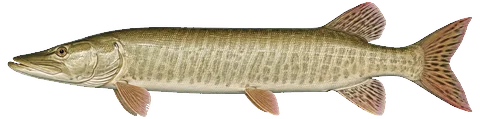
Esox masquinongy · also called muskie
- Size limit
- Statewide minimum 54 in (40 in on Twin Cities lakes stocked with tiger muskellunge)
- Lakes
- About 102, including 48 where the DNR introduced them by stocking
- Spawns
- Early spring, after northern pike
- Growth
- Young of the year reach about a foot by late fall
- Minnesota record
- 55 lb 14 oz, 57¾ in — Mille Lacs Lake, Mille Lacs County, 2021
Where muskellunge have been recorded
94 of the 1,788 Minnesota lakes on this site with fish records list muskellunge, across 27 counties. Tap a dot to open that lake’s depth map.
Recorded here Other lakes with fish records
How we know
- 70lakes where a DNR fisheries survey caught them
- 68lakes the DNR has stocked since 2016; 24 of them are listed on that stocking alone
A lake can appear in more than one line. A lake that isn’t listed may still have them: records exist only where someone caught, netted or stocked them.
Inland lakes on this list run from 7 to 128,184 acres (median 901) and from 4 to 135 ft deep (median 50 ft).
How many turn up in DNR surveys
Minnesota DNR lake surveys use standard gear: gill nets set offshore for 24 hours (the main gear for walleye, northern pike, yellow perch, cisco, whitefish and trout), trap nets set near shore (the main gear for bluegill, crappie and bullheads), and on some lakes electrofishing, most often for bass. The DNR reports each gear separately, as fish per net set. These rates come from the newest standard survey of each lake on this site, 1959–2025 — a measure of how many fish a lake holds, not how many an angler will catch.
- Found in
- 40 of 1579 lakes surveyed this way
- Typical rate
- 0.11 per gill net where found
- Highest
- 0.88 per gill net
- Method
- fish per gill net set
“Typical” is the median across the lakes where the survey caught at least one. Each gear catches different fish, so the rates are not added together. In trap nets it turned up in 18 lakes at a typical 0.11 per trap net set. By electrofishing it turned up in 5 lakes at a typical 0.56 per hour of electrofishing. A single survey is a snapshot of one season.
Highest survey rates on this site
- Dumbbell Lake, Lake County 2023 0.88
- Elk Lake, Clearwater 2025 0.67
- Little Wolf Lake, Cass 2024 0.56
- Andrusia Lake, Beltrami 2019 0.25
- Cedar Island Lake (Main Bay), Stearns 2018 0.25
- Crescent Lake, Cook 2024 0.25
- French Lake, Rice 2023 0.25
- Lake Owasso, Ramsey 2021 0.25
- Moose Lake, Itasca 2023 0.25
- Lake Independence, Hennepin 2025 0.22
Fish per gill net set, with survey year. Survey effort and season differ between lakes.
Often found with
Share of these lakes that also list each fish.
How to recognize it
A long pike-shaped fish, silver, light green or light brown with dark bars or spots on a light background (the reverse of a northern pike). The sure test: six or more sensory pores on each side of the underside of the lower jaw.
Don’t confuse it with
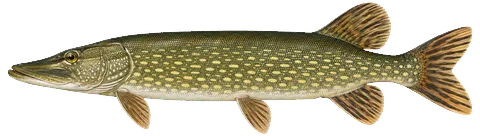
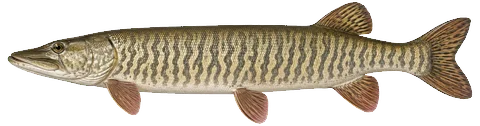
Up close
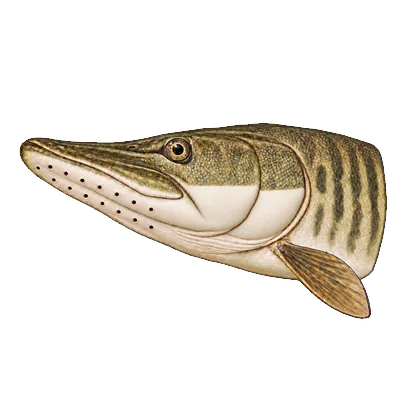
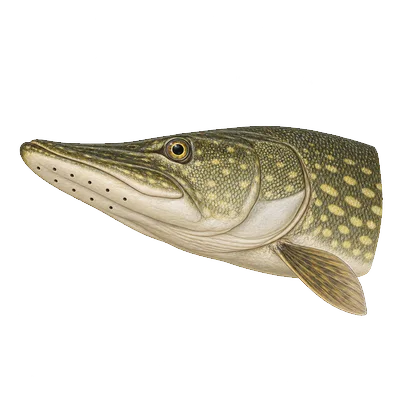
AI-generated close-ups, not photographs, drawn from the cited descriptions. They show what to look for; they are not a substitute for an expert identification (provenance).
Life in a Minnesota lake
The biggest of the pike family, muskellunge are native to Minnesota's lakes and rivers and famously take many casts to hook. According to the DNR, that difficulty comes from how few live in any one lake rather than from any special cunning. They ambush prey from weed edges, rocky shoals and points that fall off into deep water.
Spawning lasts roughly a week in early spring, with eggs adhering to vegetation and the lake bottom. Diet research by the DNR showed muskellunge do not strip a lake of fish: in the lakes studied, northern pike and largemouth bass ate more than muskellunge did.
Source: the sources below.
Rules and eating
Check the rules before you keep fish. Each lake page shows the regulations that apply there, and the Minnesota DNR fishing regulations page is the official source. Before eating fish from a particular lake, check the Minnesota Department of Health’s fish consumption guidance.
All 94 lakes with muskellunge
Show every lake, by county
Aitkin County 3
Cedar Lake (Main Basin), Cedar Lake (N.E. Arm), Cedar Lake (West Bay)
Becker County 4
Beltrami County 7
Andrusia Lake, Big Lake, Cass Lake, Kitchi Lake, Lake Bemidji (main lake), Lake Irving, Wolf Lake
Carver County 1
Cass County 12
Baby Lake, Boy Lake, Gull Lake, Lake Winnibigoshish, Leavitt Lake, Leech Lake (Kabekona Bay), Leech Lake (Main Basin), Little Boy Lake, Little Wolf Lake, Man Lake, Pike Bay, Roosevelt Lake
Chisago County 3
Clearwater County 1
Cook County 1
Crow Wing County 1
Douglas County 6
Lake Ida, Lake Louise, Lake Miltona, Lake Mina, Lobster Lake (East Bay), Lobster Lake (West Bay)
Hennepin County 9
Bde Maka Ska, Cedar Lake, Eagle Lake, Highland Park Pond, Lake Harriet, Lake Independence, Lake Minnetonka, Lake Rebecca, Tanager Lake
Hubbard County 6
Lake Plantagenet, Mantrap Lake (East Basin), Mantrap Lake (Home Bay), Mantrap Lake (Middle Basin), Mantrap Lake (Mirror Bay), Mantrap Lake (West Arm)
Itasca County 7
Blandin Lake, Deer Lake, Moose Lake, North Star Lake, Pokegama Lake (Main Bay), Pokegama Lake (Wendigo), Spider Lake
Lake County 1
Martin County 6
Amber Lake, Budd Lake, Fox Lake, George Lake, Hall Lake, Sisseton Lake
Mille Lacs County 1
Morrison County 3
Olmsted County 1
Otter Tail County 2
Pine County 2
Ramsey County 2
Rice County 1
St. Louis County 5
Crane Lake, East Vermilion Lake, Island Lake Reservoir (E.Basin), Island Lake Reservoir (W.Basin), West Vermilion Lake
Stearns County 5
Cedar Island Lake (East Lake), Cedar Island Lake (Koetter Lake), Cedar Island Lake (Main Bay), Cedar Island Lake (Mud Lake), Horseshoe Lake
Wadena County 1
Washington County 2
Wright County 1
Sources
- Minnesota DNR: Muskellunge
- Minnesota DNR: How to catch a muskellunge
- Minnesota DNR MinnAqua: Minnesota Fish Watch (PDF)
- Minnesota DNR MinnAqua: Fishes of Minnesota and fish family facts (PDF)
- Minnesota DNR: Fish species classification for the lake index of biological integrity (native and non-native species)
- Minnesota DNR lake surveys (LakeFinder) — lake records, stocking and survey catch rates. Minnesota DNR contributed to this work.
- Minnesota DNR state record fish (certified and non-certified weight lists; angler names are not reproduced here)