Shoreline and shallow-water plant
Flowering Rush
Butomus umbellatus
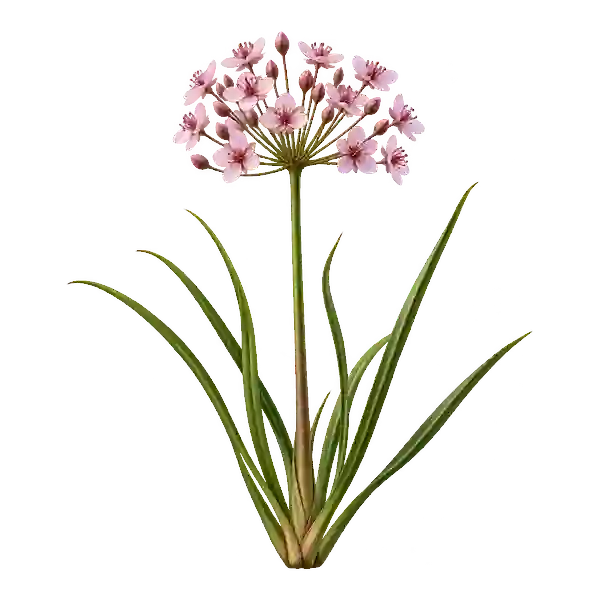

These illustrations are AI-generated, not photographs, and are not to scale. They show what to look for; they are not a substitute for an expert identification.
How to identify it
Size: Grows along shores and in shallow water. It can also grow completely underwater, where it does not flower.
- Long, narrow leaves that are triangular when you cut across them, often twisting near the tip.
- In summer, a rounded, umbrella-shaped cluster of pink-to-white flowers on a tall stalk.
- Each flower has three broad petals and three smaller sepals, with darker veins and red centers.
Don’t confuse it with
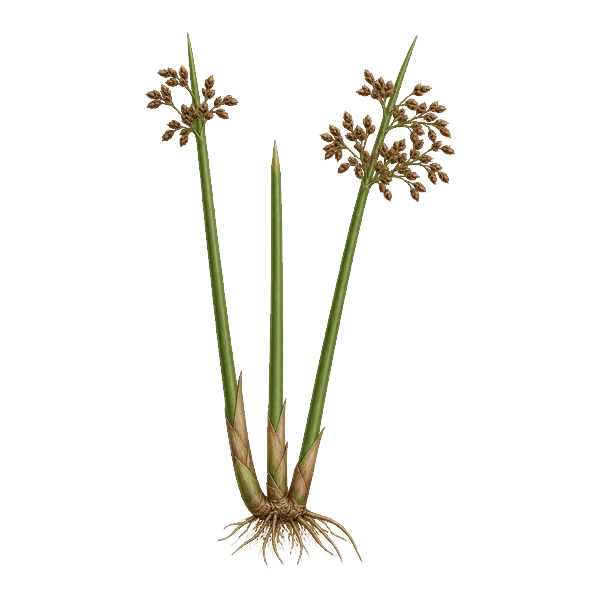
Without flowers it can pass for native bulrushes or bur-reeds. Flowering rush's leaves are triangular where you cut across them and often twist near the tip. Bulrushes are mostly bare stems with their leaves reduced to sheaths at the base, and some native bulrushes have three-sided stems of their own, so shape alone does not settle it. If you are not sure, report it.
Where it came from
Native to Europe and Asia.
Brought to North America as a garden plant and first recorded along the St. Lawrence River in the late 1800s. It spreads by root pieces and small bulb-like buds that break off and float away.
Earliest dated Minnesota record: 1968, Bass Lake, Anoka County. This is the oldest dated record in the USGS non-native species database, not necessarily when it first arrived.
Why it matters
It forms dense stands along shores and in shallow water that crowd out native plants and can get in the way of swimming and boating.
Minnesota law
Designated a prohibited invasive species under Minnesota Rules 6216.0250. It is illegal to possess, import, purchase, transport or introduce it, except under a DNR permit for disposal, control, research or education. Named in Minnesota Rules 6216.0250, subpart 2, item I. Minnesota DNR’s summary of these laws.
If you find it
- Don’t move it. Minnesota law requires you to clean aquatic plants and prohibited invasive species off boats, trailers and gear, and to drain all water and leave drain plugs out while transporting. Launching a boat or trailer with aquatic plants, zebra mussels or other prohibited invasive species attached is illegal, and docks, lifts and rafts must stay out of the water for 21 days before going into another body of water. What Minnesota law requires
- Never release bait or pets. Minnesota law forbids dumping bait in any lake or river: put unwanted bait in the trash. Never release bait, plants or aquarium pets into Minnesota waters.
- Report it. Note the exact location, take a photo, and contact the Minnesota DNR aquatic invasive species specialist for your region, or call the DNR at 888-646-6367. Experts there can confirm what you found.
- Ask before removing or treating. Aquatic plants in Minnesota public waters belong to the state. Applying herbicides always needs a DNR permit, and so does cutting or pulling submerged plants over more than 2,500 square feet. When a permit is needed
Minnesota lakes where it has been recorded
31 Minnesota lakes on this site have a record of this species.
Aitkin
Dakota
Douglas
Goodhue
Hennepin
Le Sueur
Otter Tail
Ramsey
Washington
Wright
A lake that is not listed may still have it. Records exist only where someone found the species and reported it, so “not recorded” does not mean “not present.”
Lake records: the Minnesota DNR List of Infested Waters (September 9, 2026). A lake counts here only where the DNR lists the species as confirmed in that water. Lakes listed only because they connect to an infested water are not counted.
Sources
- University of Nevada Extension: Flowering rush
- Minnesota Rules 6216.0250: Prohibited invasive species
- Minnesota Rules 6216.0265: Permits for prohibited and regulated invasive species
- Minnesota DNR: Minnesota invasive species laws
Earliest dated record: USGS Nonindigenous Aquatic Species database.