Underwater plant
Eurasian Watermilfoil
Myriophyllum spicatum
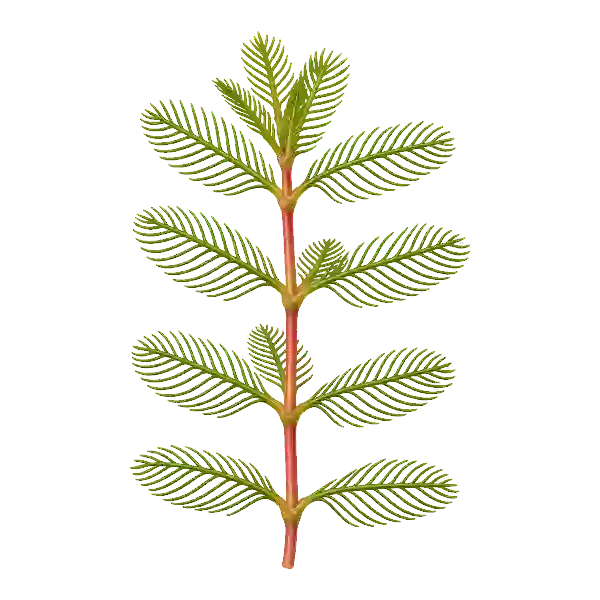
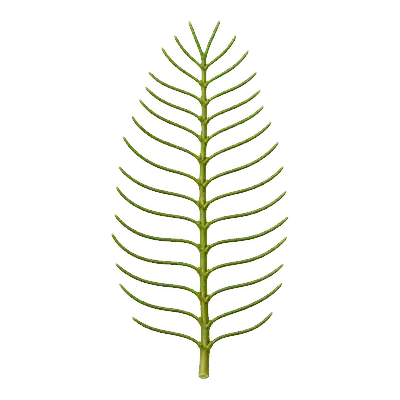
These illustrations are AI-generated, not photographs, and are not to scale. They show what to look for; they are not a substitute for an expert identification.
How to identify it
Size: Leaves about 1/2 to 2 inches long, on long stems that can reach the surface.
- Soft, feathery leaves in rings (whorls), usually four to a ring, around the stem.
- 12 or more pairs of thread-like leaflets on each leaf. Count them: this is the most useful check.
- Leaf tips that often look blunt, as if clipped off.
- Reddish stem tips, often branching near the surface.
Don’t confuse it with
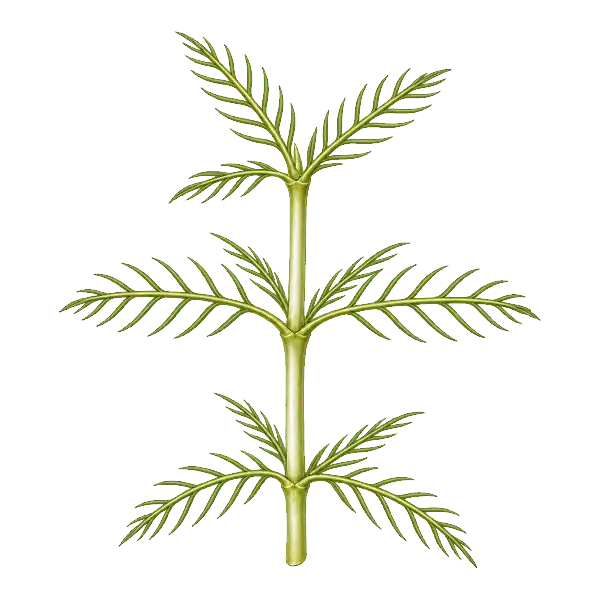
Native northern watermilfoil usually has fewer leaflet pairs, about 5 to 10, and stiffer leaves. The two can also cross, and the hybrid can be hard to tell apart without a lab test.
Where it came from
Native to Europe, Asia and northern Africa.
Established in North America by the mid-1900s. It spreads between lakes mainly as plant pieces caught on boats, trailers, motors and fishing gear. A single piece can start a new plant.
Earliest dated Minnesota record: 1935, Lake Owasso, Ramsey County. This is the oldest dated record in the USGS non-native species database, not necessarily when it first arrived.
Why it matters
It can form thick mats at the surface that crowd out native plants, make swimming and boating difficult, and change the habitat fish use.
Minnesota law
Designated a prohibited invasive species under Minnesota Rules 6216.0250. It is illegal to possess, import, purchase, transport or introduce it, except under a DNR permit for disposal, control, research or education. Named in Minnesota Rules 6216.0250, subpart 2, item G. The rule includes its hybrids. Minnesota DNR’s summary of these laws.
If you find it
- Don’t move it. Minnesota law requires you to clean aquatic plants and prohibited invasive species off boats, trailers and gear, and to drain all water and leave drain plugs out while transporting. Launching a boat or trailer with aquatic plants, zebra mussels or other prohibited invasive species attached is illegal, and docks, lifts and rafts must stay out of the water for 21 days before going into another body of water. What Minnesota law requires
- Never release bait or pets. Minnesota law forbids dumping bait in any lake or river: put unwanted bait in the trash. Never release bait, plants or aquarium pets into Minnesota waters.
- Report it. Note the exact location, take a photo, and contact the Minnesota DNR aquatic invasive species specialist for your region, or call the DNR at 888-646-6367. Experts there can confirm what you found.
- Ask before removing or treating. Aquatic plants in Minnesota public waters belong to the state. Applying herbicides always needs a DNR permit, and so does cutting or pulling submerged plants over more than 2,500 square feet. When a permit is needed
Minnesota lakes where it has been recorded
334 Minnesota lakes on this site have a record of this species.
Anoka
Centerville Lake, Coon Lake, Crooked Lake, George Watch Lake, Ham Lake, Island Lake, Lake George, Linwood Lake, Marshan Lake, Otter Lake, Peltier Lake
Blue Earth
Ballantyne Lake, Eagle Lake (North), Lura Lake, Madison Lake
Carver
Burandt Lake, Eagle Lake, East Auburn Lake, Hydes Lake, Lake Ann, Lake Bavaria, Lake Grace, Lake Lucy, Lake Minnewashta, Lake Riley, Lake Susan, Lake Virginia, Lake Waconia, Lotus Lake, Oak Lake, Parley Lake, Piersons Lake, Reitz Lake, Schutz Lake, Steiger Lake, Stone Lake, Wassermann Lake, West Auburn Lake, Zumbra-Sunny Lake
Cass
Girl Lake, Gull Lake, Lawrence Lake, Leech Lake (Kabekona Bay), Leech Lake (Main Basin), Portage Lake, Roosevelt Lake, Thunder Lake, Town Line Lake, Washburn Lake
Chisago
Chisago Lake (north portion), Chisago Lake (south portion), Comfort Lake, East Rush Lake, Fish Lake, Goose Lake (North Bay), Goose Lake (South Bay), Green Lake (Main Basin), Kroon Lake, Little Comfort Lake, Little Green Lake (Little Green), Little Lake, Mandall Lake, North Center Lake, North Lindstrom Lake, Rabour Lake, South Center Lake, South Lindstrom Lake, West Rush Lake
Crow Wing
Bay Lake, Clearwater Lake, Crooked Lake (Main Bay), Crooked Lake (Sugar Bay), Kimball Lake, Lake Emily, Lake Mary, Lower Mission Lake, Mahnomen, Alstead & Arco Lake, North Long Lake, Ossawinnamakee Lake, Pine Lake, Ruth Lake, Upper Mission Lake, Upper South Long Lake, White Sand Lake
Dakota
Crystal Lake, Fish Lake, Holland Lake, Marion Lake, Orchard Lake
Faribault
Goodhue
Hennepin
Bass Lake, Bde Maka Ska, Brownie Lake, Bryant Lake, Bush Lake, Cedar Lake, Christmas Lake, Dutch Lake, Eagle Lake, East Sarah Lake, Fish Lake, Forest Lake, Lake Harriet, Lake Hiawatha, Lake Independence, Lake Minnetonka, Lake Nokomis, Lake Rebecca, Lake Smetana, Lake of the Isles, Langdon Lake, Long Lake, Lower Twin Lake, Medicine Lake, Middle Twin Lake, Mitchell Lake, North Anderson Lake, North Little Long Lake, Parkers Lake, Peavey Lake, Pike Lake, Rice Lake, Schmidt Lake, South Little Long Lake, Southeast Anderson Lake, Southwest Anderson Lake, Staring Lake, Tanager Lake, Upper Twin Lake, Weaver Lake, West Sarah Lake, Whaletail Lake, Wirth Lake
Hubbard
Mantrap Lake (East Basin), Mantrap Lake (Home Bay), Mantrap Lake (Middle Basin), Mantrap Lake (Mirror Bay), Mantrap Lake (West Arm)
Itasca
Coon-Sandwick Lake (Coon), Coon-Sandwick Lake (Sand), Hale Lake, North Twin Lake, South Twin Lake
Jackson
Kanabec
Kandiyohi
Andrew Lake, Elkhorn Lake, Games Lake, Green Lake, Henderson Lake, Lake Calhoun, Lake Florida, Norway Lake, Ringo Lake
Le Sueur
East Jefferson Lake, Frances Lake, German Lake, Lake Volney, Middle Jefferson Lake, Rays Lake, Sunfish Lake, Swede's Bay, Tetonka Lake, Upper Sakatah Lake, West Jefferson Lake
McLeod
Meeker
Belle Lake, Clear Lake, Lake Erie, Lake Minnie-Belle, Lake Ripley (west portion), Lake Stella, Lake Washington, Little Mud Lake, Manuella Lake
Mille Lacs
Morrison
Polk
Ramsey
Bald Eagle Lake, Beaver Lake, East Vadnais Lake, Gervais Lake, Island Lake (Basin N.of I-694), Island Lake (Basin S.of I-694), Keller Lake (main bay), Kohlman Lake, Lake Johanna, Lake Josephine, Lake Owasso, Lake Phalen, Lake Wabasso, Long Lake, McCarron Lake, Pleasant Lake, Round Lake, Silver Lake (East), Silver Lake (West), Snail Lake, Spoon Lake, Sucker Lake, Turtle Lake, West Vadnais Lake
Scott
Lower Prior Lake, McMahon Lake, Murphy Lake, O'Dowd Lake, Schneider Lake, Spring Lake, Thole Lake, Upper Prior Lake
Sherburne
Big Lake, Birch Lake, Eagle Lake, Elk Lake, Elk Lake, Lake Mitchell, Orono Lake, Rush Lake
Stearns
Cedar Island Lake (East Lake), Cedar Island Lake (Koetter Lake), Cedar Island Lake (Main Bay), Cedar Island Lake (Mud Lake), Great Northern Lake, Horseshoe Lake, Knaus Lake, Lake Marie, Lower Spunk Lake, Middle Spunk Lake, Otter Lake, School Section Lake, St. Anna Lake, Sylvia Lake, Zumwalde Lake
Waseca
Washington
Big Marine Lake, Bone Lake, Clear Lake, Forest Lake, Goose Lake, Lake De Montreville, Lake Elmo, Lake Jane, Long Lake, Long Lake, Long Lake, Pine Tree Lake, Plaisted Lake, Powers Lake, Sunset Lake, White Bear Lake
Wright
Beebe Lake, Birch Lake, Buffalo Lake, Camp Lake, Cedar Lake, Clearwater Lake (East), Clearwater Lake (West), Collinwood Lake, Constance Lake, Deer Lake, Dutch Lake, Emma Lake, Fish Lake, French Lake, Goose Lake, Granite Lake, Howard Lake, Indian Lake, Lake Augusta, Lake Caroline, Lake Charlotte, Lake John, Lake Mary, Lake Pulaski (main bay), Little Eagle Lake, Little Mary Lake, Little Waverly Lake, Locke Lake, Louisa Lake, Mink Lake, Mink Lake, North Twin Lake, Pelican Lake, Pleasant Lake, Ramsey Lake, Rock Lake, Round Lake, Silver Lake, Somers Lake, Sugar Lake, Upper Maple Lake, Waverly Lake, West Lake Sylvia, Wiegand Lake
A lake that is not listed may still have it. Records exist only where someone found the species and reported it, so “not recorded” does not mean “not present.”
Lake records: the Minnesota DNR List of Infested Waters (September 9, 2026). A lake counts here only where the DNR lists the species as confirmed in that water. Lakes listed only because they connect to an infested water are not counted.
Sources
- USGS Nonindigenous Aquatic Species: Eurasian watermilfoil fact sheet
- Minnesota Rules 6216.0250: Prohibited invasive species
- Minnesota Rules 6216.0265: Permits for prohibited and regulated invasive species
- Minnesota DNR: Minnesota invasive species laws
Earliest dated record: USGS Nonindigenous Aquatic Species database.